Showing posts with label Economy. Show all posts
Showing posts with label Economy. Show all posts
Chuck Woolery on Budget Cuts
| Thursday, December 15, 2011 |
0
comments
|
Labels:
Budget,
Chuck Woolery,
Debt,
Deficit,
Economy,
Spending


US Debt Visualized
One Hundred Dollars
 |
| $100 - Most counterfeited money denomination in the world.
Keeps the world moving. |
Ten Thousand Dollars
 |
| $10,000 - Enough for a great vacation or to buy a used car. Approximately one year of work for the average human on earth. |
One Million Dollars
 |
| $1,000,000 - Not as big of a pile as you thought, huh? Still this is 92 years of work for the average human on earth. |
One Hundred Million Dollars
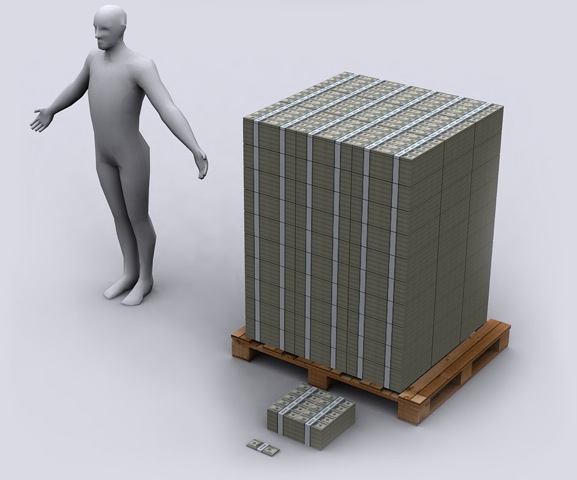 |
| $100,000,000 - Plenty to go around for everyone. Fits nicely on an ISO / Military standard sized pallet. |
One Billion Dollars
 |
| $1,000,000,000 - You will need some help when robbing the bank. Now we are getting serious! |
One Trillion Dollars
 |
| $1,000,000,000,000 - When the U.S government speaks about a 1.7 trillion deficit - this is the volumes of cash the U.S. Government borrowed in 2010 to run itself. Keep in mind it is double stacked pallets of $100 million dollars each, full of $100 dollar bills. You are going to need a lot of trucks to freight this around. If you spent $1 million a day since Jesus was born, you would have not spent $1 trillion by now...but ~$700 billion - same amount the banks got during bailout. |
One Trillion Dollars
 |
| Comparison of $1,000,000,000,000 dollars to a standard sized American Football field and European Football field. Say hello to the Boeing 747-400 transcontinental airliner that's hiding on the right. This was until recently the biggest passenger plane in the world. |
15 Trillion Dollars
 |
| $15,000,000,000,000- Unless the U.S. government fixes the budget, US national debt (credit card bill) will topple 15 trillion by Christmas 2011. The Statue of Liberty seems rather worried as United States national debt passes 20% of the entire world's combined GDP (Gross Domestic Product). In 2011 the National Debt will exceed 100% of GDP, and venture into the 100%+ debt-to-GDP ratio that the European PIIGS have (bankrupting nations). |
114.5 Trillion Dollars
 |
| $114,500,000,000,000 - US unfunded liabilities. To the right you can see the pillar of cold hard $100 bills that dwarfs the WTC & Empire State Building - both at one point the world's tallest buildings. If you look carefully you can see the Statue of Liberty. The 114.5 Trillion dollar super-skyscraper is the amount of money the U.S. Government knows it does not have to fully fund the Medicare, Medicare Prescription Drug Program, Social Security, Military and civil servant pensions. It is the money the USA knows it will not have to pay all its bills. If you live in the USA, this is also your personal credit card bill; you are responsible along with everyone else to pay this back. The citizens of the USA created the U.S. Government to serve them, this is what the U.S. Government has done while serving The People. The unfunded liability is calculated on current tax and funding inputs, and future demographic shifts in US Population. Note: On the above 114.5T image the size of the base of the money pile is half a trillion, not 1T as on the 15T image. The height is double. This was done to reflect the base of Empire State and WTC more closely. Everyone needs to see this. Source: Federal Reserve & www.USdebtclock.org - visit it to see the debt in real time and get a better grasp of this amazing number. |

Economic Freedom of North America
| Tuesday, December 6, 2011 |
0
comments
|
Labels:
America,
Big Government,
Canada,
Economy,
Freedom,
Mexico,
Property Rights,
Prosperity,
Taxes
Economic Freedom of North America is an attempt to gauge the extent of the restrictions on economic freedom imposed by governments in North America. The index published here measures economic freedom at two levels, the subnational and the all-government. At the subnational level, it measures the impact on economic freedom of provincial and municipal governments in Canada and of state and local governments in the United States. At the all-government level, it measures the impact of all levels of government—federal, provincial/state, and municipal/local—in Canada and the United States. All 10 provinces and 50 states are included.

Gene Simmons: “Capitalism is the best thing that ever happened"
'Debt crisis like fat people blaming bakers'

THE first thing I would do if I was the benevolent dictator of planet Earth would be to fire all politicians — who are basically university lecturers in positions of power.
They might be able to quote the existential philosophers but that doesn't mean they know how to run businesses.
Countries are businesses — they have imports and exports and you want your exports to be higher than your imports so you can have a profit.
You want to make sure that whatever money you give out to your population is money that you can afford to send out.
Countries are a house of cards — and when the bottom few cards fall down they all topple over. Look at Greece, Ireland, Portugal, Spain and Italy.
If businessmen ran the country, this wouldn't happen. Richard Branson would make a great PM. He's more qualified.
Government makes money by taxing and spending.
It's so simple. If you spend more than you tax, you're out of business. MPs don't know what they're talking about.
And we created this miserable economic state. It's like fat people who think it's the bakery's fault they got fat.
No, you kept going in there and you kept eating cake. It's not the bakery's responsibility to tell you to slow down.
Banks shouldn't have to tell you not to borrow so much.
They're banks — they're supposed to lend you money. If you can't afford to take out £100,000, don't take out a £400,000 mortgage.
It's your responsibility to be a grown-up and take care of yourself.
Thank God we have lending institutions and banks. The planes that fly through the sky, the phones we use every day, the cars we drive, the houses we live in, the entire economy is all funded by firms who borrow in return for interest.
This mess is our fault — corporations have no responsibility.
Capitalism is the best thing that ever happened to human beings. The welfare state sounds wonderful but it doesn't work.
Governments hand out more money than they have to support welfare and they land in debt.
Then they have to borrow money — and then there's interest on top of that.
That's bad business. And it has created a culture of entitlement.
When I was growing up my mother went to work. There was no welfare. If you worked, you made money.
If you didn't work, you had to figure it out — you'd go and wash dishes.
The new breed of 20-year-olds don't want to do those jobs.
So people from other countries come over and are thrilled to get the chance to wipe the floors.
Kiss are the only business-savvy band about and I make no apologies for that.
We outsell The Beatles and Elvis put together.
People say things like: "Oh, you make so much money. What do you need any more for?"
Well, actually, I never asked for your opinion. I'll let you know when I have enough money.
Rep. Kelly: "Our policies make Houdini look like an amateur"
| Sunday, September 18, 2011 |
0
comments
|
Labels:
Budget,
Congress,
Economy,
Mike Kelly,
Regulation
The Obama Legacy
| Wednesday, July 6, 2011 |
0
comments
|
Labels:
Debt,
Economy,
Federal Reserve,
Freedom,
Inflation,
Obama,
Obama Administration,
Politics,
Socialism,
Tea Party
Who owns your money?
| Friday, June 24, 2011 |
0
comments
|
Labels:
Debt,
Economy,
Government,
IRS,
MacIver Institute,
Paul Ryan,
Taxes
Obama Chief of Staff Says he Can't Defend Obamanomics
| Wednesday, June 22, 2011 |
0
comments
|
Labels:
Big Government,
Bureaucracy,
Economy,
Obama Administration,
Regulation

White House Chief of Staff Bill Daley took heat from business executives Thursday for the Obama administration’s regulatory expansions. Daley also said he didn’t have any good answers for some of what President Obama is doing and expressed frustration about the “bureaucratic stuff that’s hard to defend.”
“Sometimes you can’t defend the indefensible,” Daley said at a National Association of Manufacturers (NAM) meeting.
Daley couldn’t answer basic questions and continually faced criticism from the executives in the room. The business leaders even applauded each other’s criticism of the administration. “At one point, the room erupted in applause when Massachusetts utility executive Doug Starrett, his voice shaking with emotion, accused the administration of blocking construction on one of his facilities to protect fish, saying government ‘throws sand into the gears of progress....’”
Read More...
Andrew Klavan: Obama's Beach Blanket Recovery
| Monday, June 6, 2011 |
0
comments
|
Labels:
Andrew Klavan,
Economy,
George Bush,
Humor,
Hypocrisy,
Ironic,
Media Bias,
Obama,
Obama Administration
Eat The Rich!
| Sunday, April 17, 2011 |
0
comments
|
Labels:
Bill Whittle,
Economy,
Michael Moore,
Money,
Socialism,
Truth
John Stossel: I Can Balance the Budget!

The Congressional Budget Office says the current year's budget deficit will be a record $1.5 trillion. It also says that over the next decade we're on track for annual deficits of "only" $768 billion. I suspect the CBO has hired Rosy Scenario to do the bookkeeping, but let's take that number at face value.
I'm now going to balance the budget, with the help of some experts.
I'll begin with things I'm most eager to cut. Let's privatize air traffic control. Canada did it, and it works better. Then privatize Amtrak. Get rid of all subsidies for rail. That'll save $12 billion.
End subsidies for public broadcasting, like NPR. Cancel the Small Business Administration. Repeal the Davis-Bacon rules under which the government pays union-set wages to workers on federal construction projects. Cut foreign aid by half (although we should probably get rid of all of it). So far, that's $20 billion.
Oops. That doesn't dent the deficit. We have to do much more...
Read More...
Corporate taxes are self-defeating

If you were establishing a new business whose products would be produced and sold worldwide, would you set it up in the United States, which now has the world’s highest corporate-tax rate?
There is a growing realization that the U.S. is at an increasingly competitive disadvantage when it comes to taxing corporations. (See accompanying chart.) Even the Obama administration said it is open to a corporate-tax rate cut, and it is expected that President Obama will propose some rate reduction in his forthcoming State of the Union address.
From a purely economic standpoint, it makes no sense to tax corporations at all, because only people pay taxes, not legal entities. The corporate tax is paid by customers in terms of higher prices, by suppliers in terms of lower volumes of business, by employees in terms of lower wages and by stockholders in terms of lower returns. Many countries used to have higher corporate-tax rates than the United States, but, over time, they realized they were losing business - and jobs - to countries with lower rates; so most countries have been reducing their corporate-tax rates to attract new businesses and global firms.
Read More...
Estate Tax Often Hits Wrong Target
| |
0
comments
|
Labels:
Economy,
IRS,
Taxes

For as long as there have been politicians, politicians have hidden their true purposes by giving laws names that disguise what they actually do. One such law is the estate tax.
It should be called the "death tax." Just as a sales tax is paid when somebody sells you something, and an income tax is triggered when you earn income, the death tax comes when you die. So rather than conjure visions of IRS grave robbing, the politicians named it the estate tax.
When Congress at the end of last year voted to keep the Bush-era tax rates in place through 2012, it made one huge exception: It voted to increase the death tax from zero to 35 percent for the next two years. This will apply to all estates valued at more than $5 million. Beginning in 2013, the rate will increase again, to 55 percent, on estates valued at more than $1 million.
Many estates, however, consist of business assets. And this looms large when business owners make plans.
If, because of the death tax, the Internal Revenue Service will claim more than a third of what you own after you die, you will act differently than you would if there were no estate tax.
You might, for example, purchase life insurance to cover the cost of the tax. Or you might put your assets in a trust. Money that is spent this way, however, is money that isn't being used to grow your business.
Read More...
The Economic Stimulus That Wasn't
| Tuesday, February 1, 2011 |
0
comments
|
Labels:
Economy,
Keynesianism,
Obama Administration,
Stimulus Plan

Economy: Did the hundreds of billions spent to stimulate the economy do the job? And where did all that money go, anyway? A new report crunches the data and finds answers that are devastating for stimulus backers.
Done by Stanford University economists John Cogan and John Taylor and published in Commentary Magazine, the report is blunt in its assessment of President Obama's Keynesian stimulus package: "There was little if any net stimulus."
Worse, say the authors, the White House with its bevy of hip Keynesian-leaning economists should have known it wouldn't work. "The irony," they write, "is that basic economic theory and practical experience predicted this would happen." In other words, the Obama camp should have known better.
Read More...
New-home sales in 2010 fall to lowest in 47 years

WASHINGTON (AP) -- Buyers purchased the fewest number of new homes last year on records going back 47 years. Sales for all of 2010 totaled 321,000, a drop of 14.4 percent from the 375,000 homes sold in 2009, the Commerce Department said Wednesday. It was the fifth consecutive year that sales have declined after hitting record highs for the five previous years when the housing market was booming.
The year ended on a stronger note. Buyers purchased new homes at a seasonally adjusted annual rate of 329,000 units in December, a 17.5 percent increase from the November pace.
Still, economists say it could be years before sales rise to a healthy rate of 600,000 units a year. "The percentage rise in sales looks impressive but 10 percent of next-to-nothing is still next-to-nothing," said Ian Shepherdson, chief U.S. economist at High Frequency Economics, referencing the December increase. "New home sales are bouncing around the bottom and we see no clear upward trend in the data yet."
Read More...
Final Tab for Pelosi’s Speakership: $5.34 Trillion in New Debt
Final Tab for Pelosi’s Speakership: $5.34 Trillion
in New Debt — or $3.66 Billion Per Day…

In the 1,461 days that Rep. Nancy Pelosi (D.-Calif.) served as speaker of the House, the national debt increased by a total of $5.343 trillion ($5,343,452,800,321.37) or $3.66 billion per day ($3.657,394,113.84), according to official debt numbers published by the U.S. Treasury.
Pelosi was the 52nd speaker of the House. During her tenure, she amassed more debt than the first 49 speakers combined.
Read More...

