Showing posts with label Deficit. Show all posts
Showing posts with label Deficit. Show all posts
Chuck Woolery on Budget Cuts
| Thursday, December 15, 2011 |
0
comments
|
Labels:
Budget,
Chuck Woolery,
Debt,
Deficit,
Economy,
Spending


US Debt Visualized
One Hundred Dollars
 |
| $100 - Most counterfeited money denomination in the world.
Keeps the world moving. |
Ten Thousand Dollars
 |
| $10,000 - Enough for a great vacation or to buy a used car. Approximately one year of work for the average human on earth. |
One Million Dollars
 |
| $1,000,000 - Not as big of a pile as you thought, huh? Still this is 92 years of work for the average human on earth. |
One Hundred Million Dollars
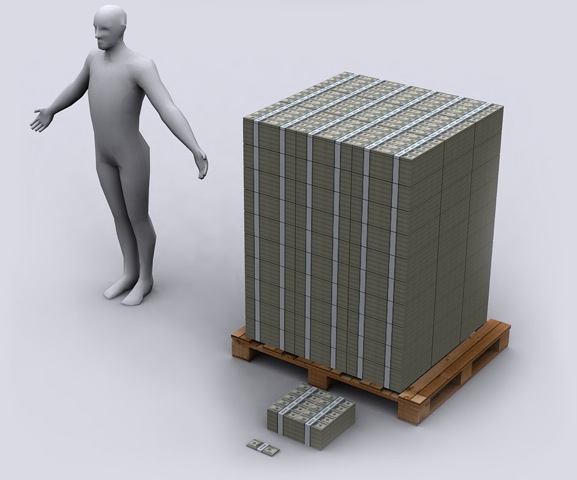 |
| $100,000,000 - Plenty to go around for everyone. Fits nicely on an ISO / Military standard sized pallet. |
One Billion Dollars
 |
| $1,000,000,000 - You will need some help when robbing the bank. Now we are getting serious! |
One Trillion Dollars
 |
| $1,000,000,000,000 - When the U.S government speaks about a 1.7 trillion deficit - this is the volumes of cash the U.S. Government borrowed in 2010 to run itself. Keep in mind it is double stacked pallets of $100 million dollars each, full of $100 dollar bills. You are going to need a lot of trucks to freight this around. If you spent $1 million a day since Jesus was born, you would have not spent $1 trillion by now...but ~$700 billion - same amount the banks got during bailout. |
One Trillion Dollars
 |
| Comparison of $1,000,000,000,000 dollars to a standard sized American Football field and European Football field. Say hello to the Boeing 747-400 transcontinental airliner that's hiding on the right. This was until recently the biggest passenger plane in the world. |
15 Trillion Dollars
 |
| $15,000,000,000,000- Unless the U.S. government fixes the budget, US national debt (credit card bill) will topple 15 trillion by Christmas 2011. The Statue of Liberty seems rather worried as United States national debt passes 20% of the entire world's combined GDP (Gross Domestic Product). In 2011 the National Debt will exceed 100% of GDP, and venture into the 100%+ debt-to-GDP ratio that the European PIIGS have (bankrupting nations). |
114.5 Trillion Dollars
 |
| $114,500,000,000,000 - US unfunded liabilities. To the right you can see the pillar of cold hard $100 bills that dwarfs the WTC & Empire State Building - both at one point the world's tallest buildings. If you look carefully you can see the Statue of Liberty. The 114.5 Trillion dollar super-skyscraper is the amount of money the U.S. Government knows it does not have to fully fund the Medicare, Medicare Prescription Drug Program, Social Security, Military and civil servant pensions. It is the money the USA knows it will not have to pay all its bills. If you live in the USA, this is also your personal credit card bill; you are responsible along with everyone else to pay this back. The citizens of the USA created the U.S. Government to serve them, this is what the U.S. Government has done while serving The People. The unfunded liability is calculated on current tax and funding inputs, and future demographic shifts in US Population. Note: On the above 114.5T image the size of the base of the money pile is half a trillion, not 1T as on the 15T image. The height is double. This was done to reflect the base of Empire State and WTC more closely. Everyone needs to see this. Source: Federal Reserve & www.USdebtclock.org - visit it to see the debt in real time and get a better grasp of this amazing number. |
Disapproval Rate for Congress at Record 82% After Debt Talks

The debate over raising the debt ceiling, which brought the nation to the brink of default, has sent disapproval of Congress to its highest level on record and left most Americans saying that creating jobs should now take priority over cutting spending, according to the latest New York Times/CBS News Poll.
A record 82 percent of Americans now disapprove of the way Congress is handling its job — the most since The Times first began asking the question in 1977, and even more than after another political stalemate led to a shutdown of the federal government in 1995.
More than four out of five people surveyed said that the recent debt-ceiling debate was more about gaining political advantage than about doing what is best for the country. Nearly three-quarters said that the debate had harmed the image of the United States in the world.
Read More...

US Debt Clock
| Friday, May 20, 2011 |
0
comments
|
Labels:
Budget,
Debt,
Deficit,
Government Waste,
Spending,
US Debt Clock

"This Budget Never, Ever, Ever Reduces the Debt?"
Rep. Woodall: "This Budget Never, Ever, Ever Reduces the Debt, Is That Right?"
Secretary of Treasury admits his budget is “unsustainable”
| Sunday, February 27, 2011 |
0
comments
|
Labels:
Budget,
Debt,
Deficit,
Ironic,
Outrageous,
Spending,
Taxes
Obama Budget Contains 15 Hidden Tax Hikes
| Sunday, February 20, 2011 |
0
comments
|
Labels:
Budget,
Deficit,
Obama Administration,
Spending,
Taxes

With the release of his FY 2012 budget today, the President is attempting to brand reckless spending and higher taxes as fiscal reform. In reality, this is the same foolhardy budgeting we’ve seen over the past two years of the Obama Administration, with one difference: more spending.
Record overspending – the President’s budget calls for a record level of overspending, after the unprecedented growth of the previous two years. The plan calls for spending to reach $3.8 trillion this year, mounting 25.3 percent of GDP, the highest share since World War II. This pales in comparison to the ten-year outlook; the budget calls for $8.7 trillion in new spending, projecting outlays of $46 trillion over the next decade.
Digging the hole deeper - While CBO recently estimated the FY 2011 budget deficit would reach $1.5 trillion, President Obama’s budget overspends at the highest rate that country has ever witnessed, creating a $1.65 trillion deficit for FY 2011. The President has falsely alleged the budget will “reduce” the deficit by $1.1 trillion, neglecting to mention that this is less than one tenth of the overspending his budget requires in the next decade.
Increases taxes to fuel higher spending – Instead of cutting spending, the President is increasing taxes to grow government. The budget hikes taxes by $1.5 trillion over the next ten years while spending almost ten times that in the same period.
Read More...
John Stossel: I Can Balance the Budget!

The Congressional Budget Office says the current year's budget deficit will be a record $1.5 trillion. It also says that over the next decade we're on track for annual deficits of "only" $768 billion. I suspect the CBO has hired Rosy Scenario to do the bookkeeping, but let's take that number at face value.
I'm now going to balance the budget, with the help of some experts.
I'll begin with things I'm most eager to cut. Let's privatize air traffic control. Canada did it, and it works better. Then privatize Amtrak. Get rid of all subsidies for rail. That'll save $12 billion.
End subsidies for public broadcasting, like NPR. Cancel the Small Business Administration. Repeal the Davis-Bacon rules under which the government pays union-set wages to workers on federal construction projects. Cut foreign aid by half (although we should probably get rid of all of it). So far, that's $20 billion.
Oops. That doesn't dent the deficit. We have to do much more...
Read More...
Democrat Mythology, Part I: Tax Rates and Revenue
| |
0
comments
|
Labels:
Deficit,
Economy,
Taxes

First and most importantly, you can dispense with the sanctimonious balloon juice that Democrat politicians care about the federal deficit. Senate Democrats obviously don’t, since they insisted on larding the Clinton tax compromise with all sorts of targeted tax breaks for favored constituencies, after weeks of bleating that refusing to raise taxes was “irresponsible” because it would increase the deficit. No one who paid the slightest attention to the actions of Democrats since they took control of Congress in 2006 would believe they view deficit reduction as a priority, but here’s a fresh reminder. The deficit is only meaningful to the Left when they can use it as a club to beat down resistance to tax increases.
This leads to the important myth about tax reduction causing deficits. No belief is more crucial to the Democrat voter. It’s a lie, and giving it up is like unplugging themselves from the Matrix. There have been four major tax reductions since the implementation of the income tax, and every one of them has been followed by increased tax revenue. Yes, that includes the unspeakable Bush tax cuts, as reported in such right-wing propaganda rags as… The New York Times.
Read More...
46 Out of 50 States Nearing Bankruptcy
| Saturday, December 11, 2010 |
0
comments
|
Labels:
Budget,
Debt,
Deficit,
Economy,
Taxes,
Unemployment

While the precarious financial situation of California gets the majority of the press coverage, it is only one of many potential defaults making investors nervous. An article in the Financial Times reports growing signs that many regional deficits are beginning to resemble those of the eurozone countries.
Forty-six states have just begun fiscal year 2011 and for most the news isn’t just bad, it’s catastrophic. According to the Center on Budget and Policy Priorities, those states are “facing a Greek-like crisis.” And for all excluding Vermont, local statutes require a balanced budget. It’s not that the leaders haven’t made an effort to trim expenses; more than 230,000 state and local government jobs have been eliminated in the past two years, with thousands more occurring each month. Mark Zandi at Moody’s has estimated that states could come up short by almost $200 billion next year, resulting in the loss of almost a million more jobs. Others say the losses could be double that number.
Read More...
Why the Spending Stimulus Failed
| Friday, December 3, 2010 |
0
comments
|
Labels:
Debt,
Deficit,
Economy,
Keynesianism,
Obama Administration,
Stimulus Plan,
Taxes,
Unemployment

President Obama and congressional leaders meeting yesterday confronted calls for four key fiscal decisions: short-run fiscal stimulus, medium-term fiscal consolidation, and long-run tax and entitlement reform. Mr. Obama wants more spending, especially on infrastructure, and higher tax rates on income, capital gains and dividends (by allowing the lower Bush rates to expire). The intellectual and political left argues that the failed $814 billion stimulus in 2009 wasn't big enough, and that spending control any time soon will derail the economy.
But economic theory, history and statistical studies reveal that more taxes and spending are more likely to harm than help the economy. Those who demand spending control and oppose tax hikes hold the intellectual high ground.
Read More...
Higher Taxes Won't Reduce the Deficit

and Richard Vedder
The draft recommendations of the president's commission on deficit reduction call for closing popular tax deductions, higher gas taxes and other revenue raisers to drive tax collections up to 21% of GDP from the historical norm of about 18.5%. Another plan, proposed last week by commission member and former Congressional Budget Office director Alice Rivlin, would impose a 6.5% national sales tax on consumers.
The claim here, echoed by endless purveyors of conventional wisdom in Washington, is that these added revenues—potentially a half-trillion dollars a year—will be used to reduce the $8 trillion to $10 trillion deficits in the coming decade. If history is any guide, however, that won't happen. Instead, Congress will simply spend the money.
In the late 1980s, one of us, Richard Vedder, and Lowell Gallaway of Ohio University co-authored a often-cited research paper for the congressional Joint Economic Committee (known as the $1.58 study) that found that every new dollar of new taxes led to more than one dollar of new spending by Congress. Subsequent revisions of the study over the next decade found similar results.
We've updated the research. Using standard statistical analyses that introduce variables to control for business-cycle fluctuations, wars and inflation, we found that over the entire post World War II era through 2009 each dollar of new tax revenue was associated with $1.17 of new spending. Politicians spend the money as fast as it comes in—and a little bit more.
Read More...
Quantitative Easing Explained
| Friday, November 19, 2010 |
0
comments
|
Labels:
Deficit,
Economy,
Government Waste,
Humor,
Inflation,
Keynesianism
The Deficit Is a Symptom, Spending Is the Disease
by Michael D. Tanner

Read More...

